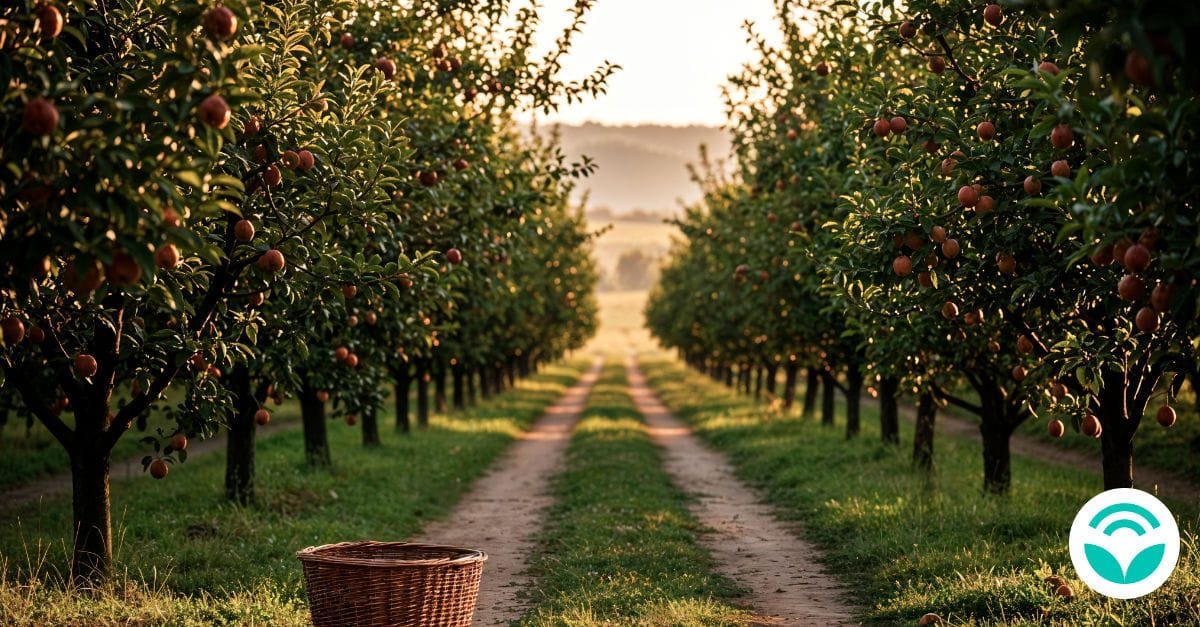
In an orchard, efficiency and capacity are not synonymous. A tree can utilize the radiation it receives very well, and yet the production system as a whole may fall short of its potential. Understanding this difference is essential to designing sustainable and economically viable plantations.
The efficient tree is not always the most productive orchard
Smaller trees tend to expose a greater proportion of their leaves to light. The canopy is easier to light, operations can be simpler and entry into production can happen sooner. This individual efficiency is valuable, especially when looking to accelerate the return on investment.
But productivity must be assessed at the orchard scale. Trees with greater volume occupy better horizontal and vertical space and are able to intercept a greater total amount of radiation. Even though each sheet is, on average, less efficient, the capacity of the set can result in greater production per area.
System design decides the outcome
Density and spacing, training method and tree vigor are interdependent decisions. The rootstock influences the size and productive capacity; conduction determines how the pantry uses space; and the compass defines how much light and productive area is available for each plant.
Intensification can bring precocity and facilitate the recovery of investment, but it is not a race to place as many trees as possible per hectare. If the reduction in size compromises light interception, load support or adaptation to soil and climate conditions, the apparent efficiency may hide a loss of capacity.
Efficiency with context
There is no universal model for all orchards. The choice must consider climate, soil, water, cultivar, labor, mechanization and commercial objective. The most useful indicator is not just the performance of a tree, but the relationship between resources used, production obtained and system stability over time.
The right question is not whether we should choose efficiency or capacity. It's like combining both so that each tree makes better use of resources without leaving productive space unused. It is in this balance that productivity stops being just a number and starts to represent a more resilient system.
